
Just Quiet
Rishon LeZion and Hod HaSharon, Israel — December 2025

“The architecture had never been configured to produce peace. It was configured to produce something quieter and more manageable — a world where the violence was periodic and the intervals between were livable. October 7th didn’t shatter the quiet. It revealed what the quiet had always required.”
Storm Byron had been building since the previous night, and by morning it had delivered on its promise: steady rain across the coastal plain, a gray sky pulled low over the highway, the kind of weather that changes the texture of a day without canceling it. I had dropped a friend at Ben Gurion earlier than expected and found myself driving southwest with time before an appointment further north — a small window in the middle of a rainy Wednesday, Rishon LeZion fifteen minutes from the airport.
Rishon LeZion doesn’t announce itself with landmarks. Agricultural fields give way to light industrial, light industrial to retail and service areas at the outskirts of town. I pulled into the parking lot of a supermarket, killed the engine, and went in.
The store was large, bright, and mid-morning busy — the particular energy of a place where people are getting on with their lives regardless of the weather outside. I moved through the aisles. At the self-checkout, I quickly discovered that I lacked the Hebrew and the local loyalty card the machine required, so I sheepishly joined the nearest line with a clerk.
The older man behind me noticed me struggling to balance my items and gestured toward his cart, offering me a place to set them down while he went back for something he’d forgotten. When he returned and I had reloaded my arms, the woman in front of me caught my eye and waved me ahead of her in line — two small acts of generosity in quick succession, neither announced nor performed.
As an anthropologist who has spent a career paying attention to how people move through shared space, what I found myself noticing wasn’t primarily the gestures of generosity directed at me — it was what those gestures revealed about the space itself. This was a community operating inside a circle of recognition. Everyone in that checkout line was, in some fundamental sense, already known to everyone else — not personally, but categorically. They were legible. They belonged. The warmth moving through the space was real, and it was also structural. It flowed along channels built over time, through shared history and shared threat and the particular solidarity that comes from both.
What the circle included was visible in the checkout line. What it excluded was not visible there at all — and that invisibility is structural, not accidental. A circle of recognition has edges. Inside those edges: legibility, warmth, the easy generosity of people who understand themselves to be in the same situation. Beyond them: something the architecture of the space is not configured to register at all. The supermarket in Rishon LeZion had no Palestinians in it. Not because they were turned away at the door, but because the decades-long system of permits, closures, and separation that scholars from Eyal Weizman to Yael Berda have documented — what Weizman mapped in Hollow Land as a macro-architecture configured toward managing the conflict rather than resolving it, what Berda traced in Living Emergency as its daily expression in Palestinian movement and restriction — had already sorted who was in the room and who was not, long before anyone arrived at the checkout line.
The warmth was real. So was the exclusion that made it possible. These are not individual choices being made in real time. What Bar-Tal documented in Intractable Conflicts as the sociopsychological infrastructure of intractable conflict — the mechanisms by which societies in prolonged conflict build collective justifications for treating the outgroup outside their normal moral framework, through accumulated beliefs, delegitimization, and what Bar-Tal calls the ethos of conflict — was operating here as quietly and as completely as the warmth itself.
The circle that made that checkout line warm is not merely analogous to the accommodation Israelis have made to living without peace. It is the same mechanism — the daily reproduction of a boundary between those whose security matters and those whose containment is the price of it — operating at the scale of a supermarket rather than a state.
Eyal answered on WhatsApp, surprised to hear I was in Rishon LeZion. He was in Hod HaSharon — forty kilometers north. I told him I’d come to him.
“You’d drive here? Really?”
I said yes. Thirty minutes wasn’t far.
His surprise was genuine. Israel is a small country, and Israelis experience it accordingly — a thirty-minute drive is a commitment here in a way it simply is not in Spokane, Washington, where I commute that distance to campus each morning without a second thought. The geography matters beyond the cultural curiosity. A country where thirty minutes registers as a significant journey is also a country where nothing is far enough away to be truly elsewhere. There is no buffer. There is nowhere to go where you can leave it all behind.
Eyal opened the door before I had finished knocking. Zero to sixty — no warmup, no circling, straight into conversation as though we had known each other for years rather than minutes. This is one of the things I have always enjoyed about Israelis: the capacity to treat a stranger as someone already worth knowing, completely and immediately, without the graduated build up that characterizes introductions in other places.
He offered coffee, then paused. “Or should we get falafel?” We went for falafel.
He drove us to his spot — two brothers, he explained with evident relish, who had a falling out years ago and now run competing stands directly across the street from each other, neither speaking to the other, both apparently excellent. We pulled up to the brother he preferred, ordered, found a table, and settled in.
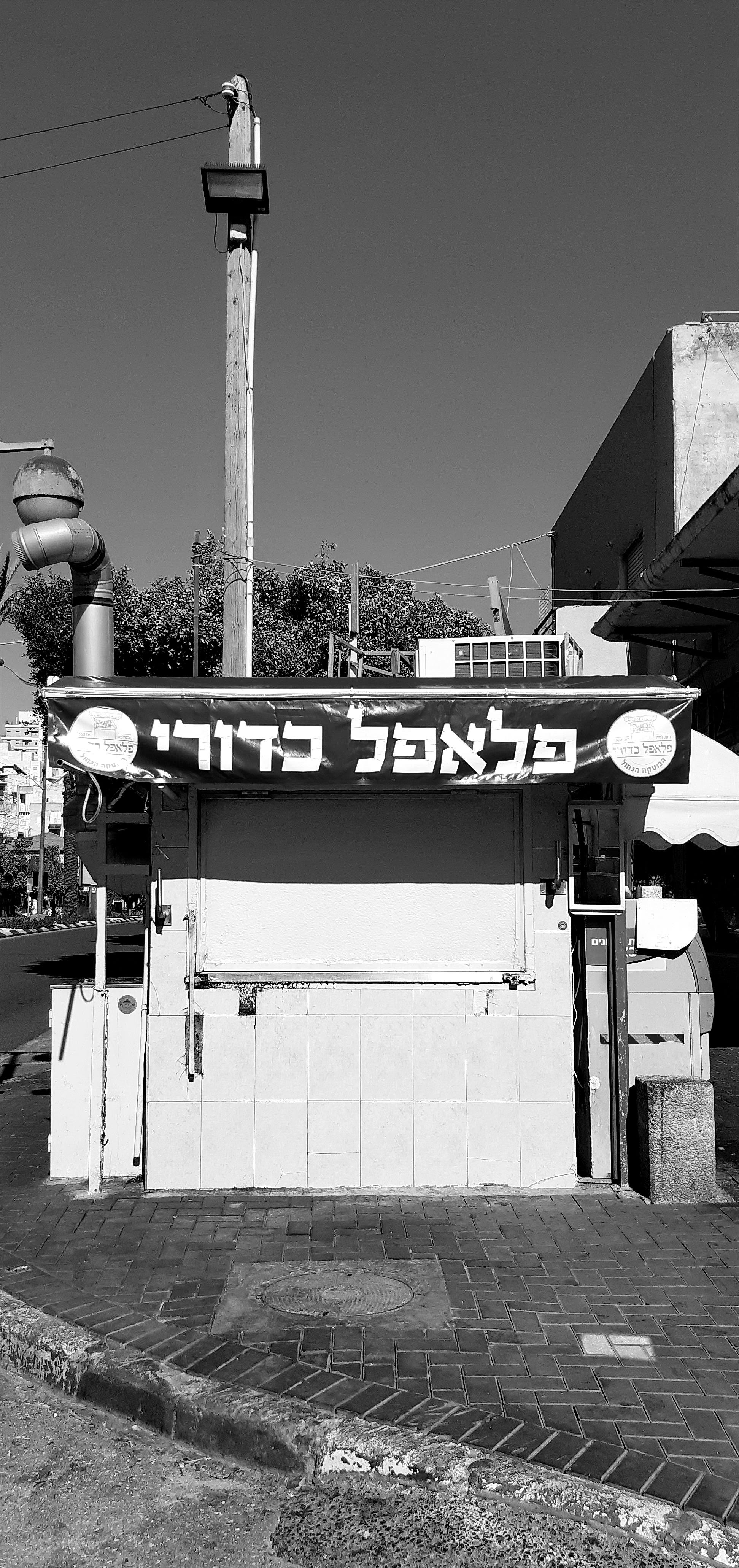
And then, in the way that Israelis have, we began to talk about the situation.
I have noticed this for as long as I have been coming here: Israelis don’t talk about the occupation, the conflict, the wars. They talk around them. The Irish have The Troubles. Israelis have the situation — a phrase capacious enough to contain everything and specific enough that no one who lives here needs it explained. We did not name October 7th. We did not name Gaza. We talked about how things are, how things have changed, how the situation has become very hard. The shared grammar of people who already understand each other, in no hurry to be more precise.
Eyal was thinking about leaving Israel. Maybe Italy. Maybe the United States. He wasn’t sure of the destination.
What he was sure of was that something had shifted after October 7th in a way that felt different from before — and he had lived through plenty of before. In other years, when rockets fell and the latest crisis passed, life had resumed. The Oslo period had carried its own specific hope, a genuine aspiration toward resolution that the years since had quietly extinguished. After Oslo failed, Eyal and people like him had made a different accommodation: peace was unlikely in his lifetime, probably, but quiet was possible — periods of manageable instability, intervals between the acute crises, a life that could be built inside the spaces the conflict left alone. Israelis are, at heart, homebodies, deeply attached to their neighborhoods and communities. They endure a great deal in order to stay.
What I understood, sitting across from him, was that October 7th had not simply traumatized him. It had destroyed the accommodation itself. The floor had dropped out. Quiet was what he had built his life on. Peace was what he hoped for, distantly, without urgency. Now quiet was what he hoped for, and he wasn’t sure he was going to get it back.
I drove back through the rain toward Jerusalem, thinking about the supermarket in Rishon LeZion and about Eyal, and about what connected those two moments. The checkout line warmth was the social expression of the same system that had configured Eyal’s accommodation. Neither was individually chosen. Both were what the architecture had configured people to produce and to endure.
The social and political architecture had never been configured to produce peace. It had been configured to produce something quieter and more manageable — a world where the situation could be named without being solved and life could continue in the spaces it left alone. Two people meeting for the first time could sit across a falafel table and understand each other perfectly without saying any of this aloud, because it was the water they had both been swimming in for as long as either of them could remember.
October 7th didn’t simply shatter the quiet. It revealed what the quiet had always required: that the architecture hold, that the circle stay intact, that everything beyond its edges remain, if not resolved, then at least contained. When that failed — in a country small enough that there was nowhere far enough away to absorb it — what collapsed wasn’t just the quiet. It was the belief that quiet had ever been a foundation rather than a postponement. That belief had sustained not just Eyal but the entire international apparatus of ceasefires, negotiations, and “calm periods” — even during the Oslo years, when the aspiration toward resolution was genuine, the underlying architecture continued to be configured toward management rather than resolution. The aspiration and the structure were never aligned. All of it had been premised on the assumption that managed intervals were progress toward something, rather than the thing itself.
Eyal knew this. I think he had known it before he said it.