
Good, He Should Go
Wanting to leave is not the same thing when one side of the equation has no return address.

The first time I met Adel Yahya, we were presenting in the same session at the Fifth World Archaeological Congress in Washington, D.C., in June 2003. We discovered camaraderie and a sense of intellectual kinship in how we both saw cultural heritage functioning within contested spaces — the politics of it, the violence of it, the way heritage gets mobilized by competing claims to the same ground. By the end of the congress, he had offered to help arrange my first trip to Palestine. I arrived in May 2004. The Second Intifada was in its fourth year.
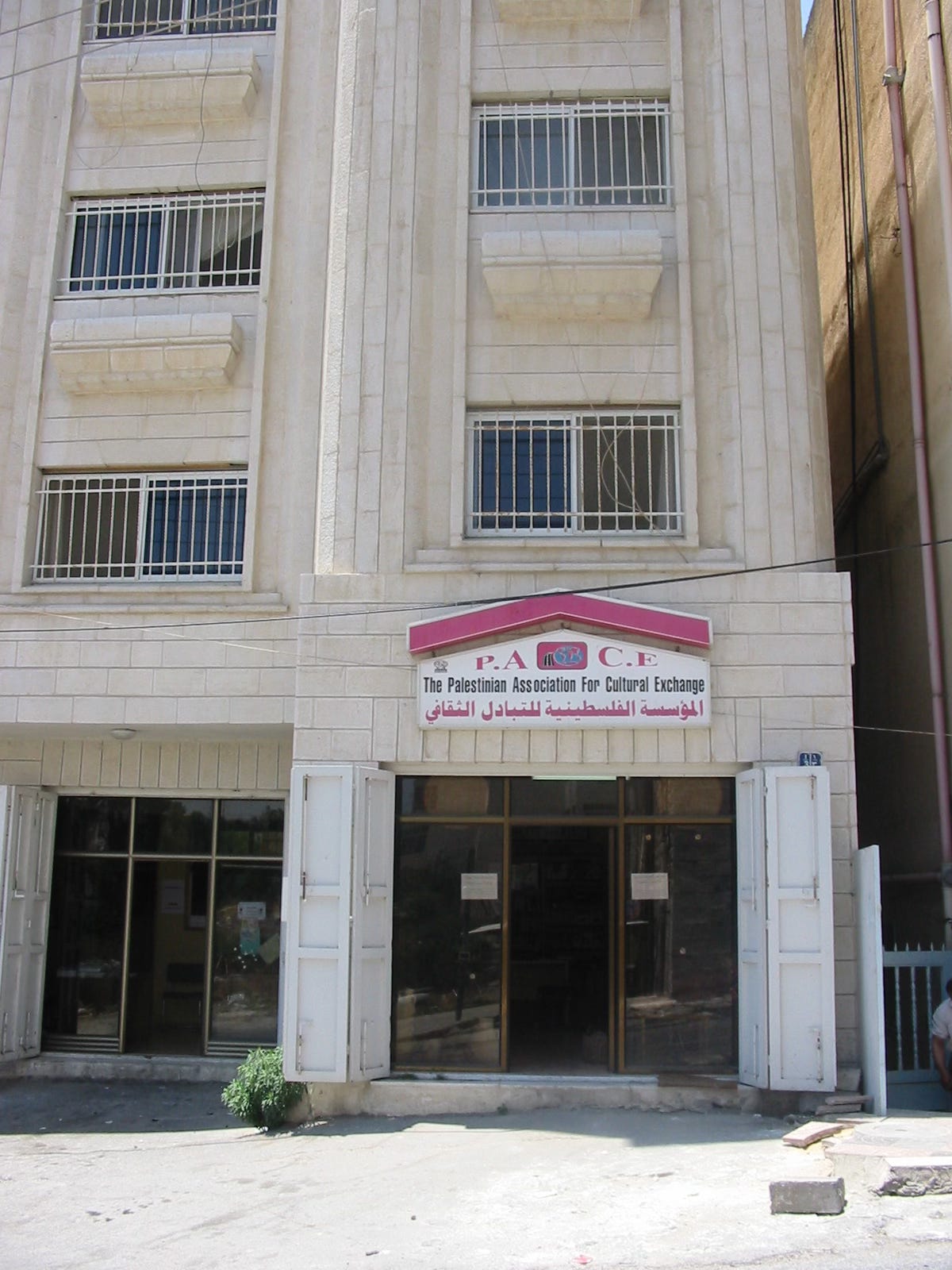
What he arranged was not just logistics. He picked me up at the Qalandia checkpoint, found me housing, gave me office space in his building on Khalid bin al-Waleed Street in al-Bireh, took me into communities I would never have reached alone, and introduced me to a way of doing fieldwork in which the researcher’s relationship to the place is understood as part of the research rather than a contamination of it. He was an archaeologist by training and the founder of the Palestinian Association for Cultural Exchange. The first floor of his building housed a small shop selling Palestinian handicrafts — ceramics and glass from Hebron, olive wood carvings from Bethlehem, olive oil soap from Nablus, embroidery made by women in villages throughout the West Bank. He died a decade ago.
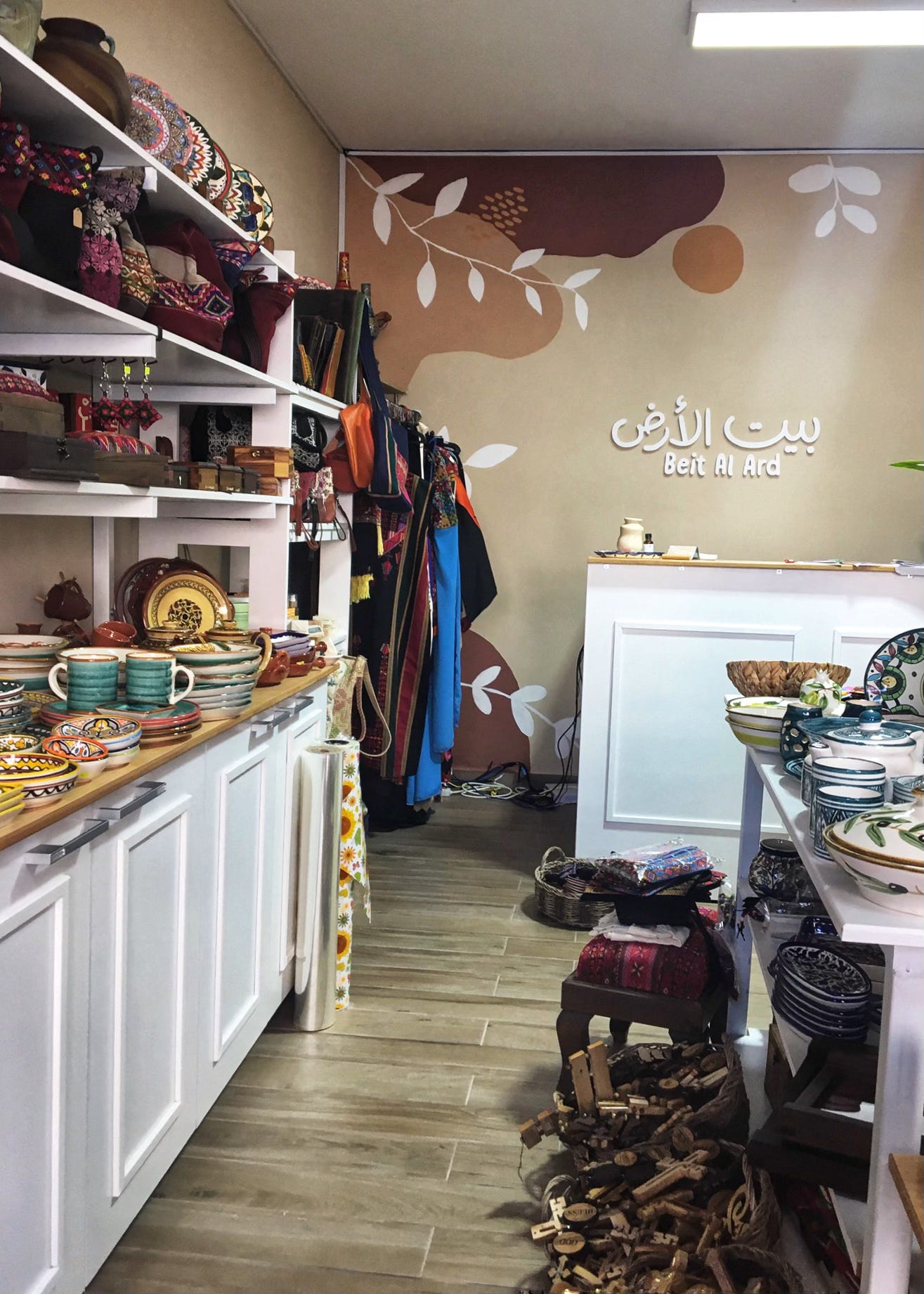
I visit with Adel’s family every time I come to Palestine. As soon as travel became possible after COVID, my family’s first trip was to Israel and Palestine where we spent time with Adel’s wife Lena, his daughter Lama and his son Qais. I had been in touch with them for weeks before this visit, arranging to meet. When I arrived, Lena and Lama were closing up Beit al-Ard — the shop Lama has built in the space where her father worked. The handicrafts are still there, but the shop has become something of its own: modern, fashionable, the work of contemporary Palestinian artists and local artisans, carefully curated. Lama’s vision for it is clear — a place that brings together art and culture, connecting buyers with makers. The international discourse around Palestine tends to freeze Palestinian life in the past, often at the moment of loss. What I was looking at was something that had kept moving.
The drive to Samer Restaurant is perhaps three blocks. Lama drove. Palestinians seldom walk when they can drive, and no one was walking that night — it had been raining for two days by then, a cold and heavy December rain that had cleared the streets and fogged every window. Lena’s hip was a few months out from replacement — there was never any question about the car. We got in, the blowers no match for the moisture coming off our coats and the rain outside, and we crept through the traffic and parked half a block away from Samer. It almost certainly took longer than walking would have. No one mentioned this.
Lena held my hand when we walked from the car to the restaurant door. She moved carefully, still learning to trust the new hip, and leaned slightly on my shoulder. I have known this woman for twenty years. The lean meant something specific: not need, exactly, but permission — the kind of ease that doesn’t perform itself, that simply is.
Samer was full. Families, friends, Arabic pop music competing with the sound of rain on glass. Fluorescent lighting that should have felt institutional — and would have, in another context — was warmed instead by the noise and color of a room full of Palestinians having dinner. The first floor was packed; we went upstairs.
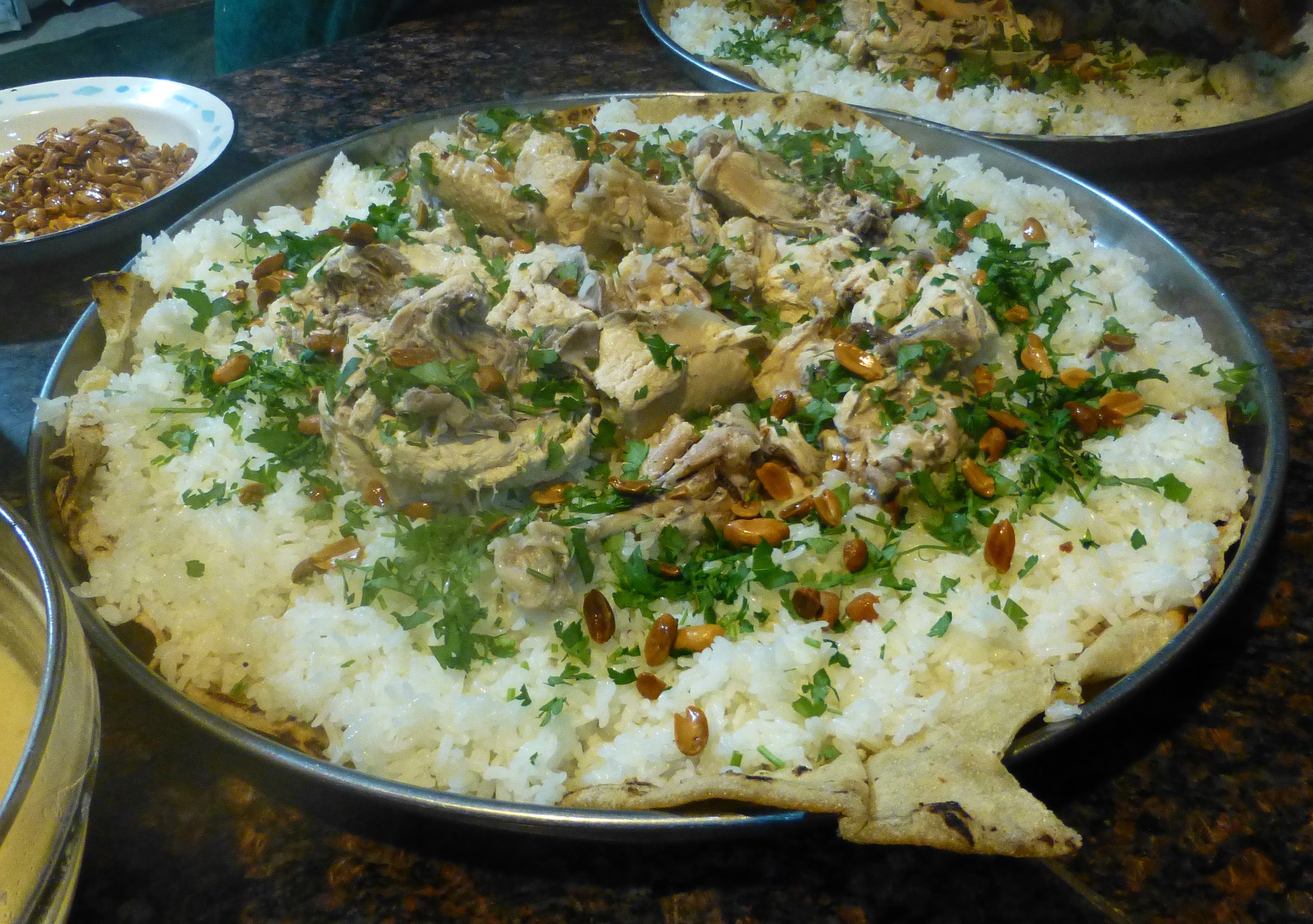
We ordered — or rather, Lena and Lama ordered, which is how Palestinian guest culture works. You do not feed yourself in someone else’s home, and Samer Restaurant, for this family, was close enough to home that the same rules applied. I had mentioned, at some point, that I’d loved mansaf since my first time in Jordan in 1998. Three servings arrived. Six kibbeh, fried, still hot. The table disappeared under the food. We all laughed when it came.
Lama asked, in the way Palestinians always ask internationals at a shared table — knowing the answer, asking anyway, because the asking is its own form of hospitality — do you know kibbeh? I said I did. I said I had tried to make them, which was true, and that I could never form the shell properly. The shell is fine bulgur wheat worked into a dough, stuffed with spiced meat and pine nuts, sealed and shaped into a football — the pointed ends are the part that defeats most people who try it outside a kitchen where someone already knows how. I said I always ended up with something round and not particularly convincing. Lena laughed and said she often makes them round too. The football shape, she said, was too much trouble — she just does balls. This is an excellent cook, a woman who has fed me well on multiple occasions. It was a small and funny and important moment: the knowledge of how to make the shape lives in hands, passed between generations in kitchens, and it does not transfer through instruction alone. This is true of almost everything that matters here.
I have known Lama since she was twelve years old. She sounds like her father — the accented English, the particular cadence of it, the way her pitch rises when she is making a point or setting up a joke. Adel had that same rise. When she speaks, I keep hearing him. She has his economy of expression, the same slight humor, the same refusal, calm and complete, to perform comfort for an occupation she has lived inside her entire life. The dead persist in the living in ways that no archive captures.
I was trying to tell Lena what Adel had meant to me — that he had made my career in this part of the world possible, that I miss him, that I hoped talking about him here, in a restaurant he had loved, was a kind of joy and not only a kind of grief.
She listened. Then she said: We are very happy you are here. It is a special day. It has been ten years today since Adel died, and we are so happy to be spending it with you, talking about him.
I had not known. I said so. I said I was so glad to be there.
This is the kind of thing that gets missed by the conflict’s usual attention span. Not the death — deaths get counted, catalogued, entered into the record. What gets missed is the decade that follows: the table set around an absence, the anniversary that arrives every year whether or not anyone outside the family knows to mark it. The international engagement with Palestinian loss tends toward the acute and the visible. What I was sitting inside was chronic and quiet, which is where most of grief actually lives.
Adel wasn’t the only person missing from the table. His son couldn’t join us — he was at the university, studying for his final exams. He is around nineteen or twenty now, born into a world his father shaped and then left. We packed up the leftovers for him. There was plenty. I thought back to Adel and how he too would have made sure the food made it home. Some things pass between generations without being taught.
Earlier that week, I had spent an afternoon in Hod HaSharon with an Israeli man named Eyal. He was thoughtful, warm, exhausted. He had been talking about leaving — maybe Italy, maybe the United States. The conflict had worn him down. He wanted quiet, somewhere he didn’t have to carry all of this. I understood what he meant. Adel had not had the option of leaving. His death was not chosen and not reversible. I thought of that, sitting with Eyal, and I thought of it again at the table with Lena and Lama.
There is an asymmetry at the center of this conflict that is rarely named precisely. The United States government has spent decades worrying about Israelis — their security, their trauma, their right to exist without fear. That concern is legitimate. But it has translated into something concrete and consequential: military aid, diplomatic cover, and a UN Security Council veto deployed repeatedly to ensure that the deaths B’Tselem and Human Rights Watch document with precision never become the subject of binding international accountability. The diplomatic asymmetry mirrors the media one documented by researchers from Philo and Berry to Marda Dunsky. The data on Palestinian deaths exists. It is carefully collected. It is known by the most powerful government in the world and treated — in the language of US diplomatic practice — as a different category of loss: not unjustified, perhaps, but somehow acceptable; not entirely Israel’s fault, but somehow the predictable consequence of Palestinian choices.
The result is a narrative in which Israeli exhaustion receives sympathy and Palestinian exhaustion receives silence.
Lena and Lama are not people who hate Israelis. They have Jewish friends. They have Israeli friends. They have hosted my wife — whose mother was Israeli — at their table without hesitation or performance. What they do not do, what they have no particular reason to do, is extend collective sympathy to a community that has, collectively, built and maintained and voted for and lived inside a system that has made their lives smaller, harder, and more precarious with every passing year. This is not a moral failure. This is what it looks like to be human inside an occupation.
I told them about Eyal. About the exhaustion, the search for quiet, the desire to leave.
They listened. Then Lama said: “Good, he should go.”
Not with malice. Not with heat. Matter-of-fact, the slight humor in it, her pitch rising just the way her father’s used to. What she was not doing was wishing him harm. What she was doing — what both of them were doing, Lena nodding beside her — was expressing, with precision, what it feels like to watch someone with every resource required to leave a difficult situation contemplate leaving it, and to understand that you will never have that option. He has a passport that makes leaving a choice. For most Palestinians, leaving is not a choice in the same way — it is something that happens to you, or something you lose the option of when you lose the option of returning. Wanting to leave is not the same thing when one side of the equation has no return address.
Adel would have said the same thing. I know this because Lama said it, in his cadence, with his humor. The dead persist in the living in ways that no archive captures.
After dinner we drove back to Beit al-Ard. I picked up the pieces Lama had set aside — Palestinian ceramics, a few small works by local artists that my wife had asked me to bring home. We said our goodbyes. Then I got in my car and drove back to Jerusalem, two hours through the rain and the dark and the traffic that belongs to both sides of the separation barrier equally.
I thought about what it would take for more people to sit at that table. Not the dinner table — the position. The years of return, the relationships built slowly enough to include a lean on a shoulder in the rain, the willingness to hear “Good, he should go” and understand it as something more precise than hostility. Most people who care deeply about this conflict are working with pieces of what that table requires. They have the knowledge but not the access, or the access but not the time, or the time but not the framework to understand what they’re seeing. The architecture of the conflict was configured, in part, to make sure of that — to keep the populations most affected from ever sitting across from each other long enough for the humanity to become undeniable.
What stays with me is the chaotic, indifferent press of cars that doesn’t know or care which city you came from or which passport you’re carrying.