
Coming Back
Ramallah, Palestine - December 2025

“The colonized world made larger, the colonial powers made smaller — one deliberate act of reframing, hanging on the wall of a café in a city that has been reframed by outside powers for centuries.”
The first mistake was listening to the navigation system.
I have made the drive from Jerusalem to Ramallah more times than I can accurately count — somewhere north of a hundred, probably closer to two. I know the route the way you know the layout of a house you lived in for years: not by thinking about it, but by moving through it. East along the Old City walls, out through French Hill, down to the Hizma checkpoint, then the settler roads through the West Bank that cut over towards Jaba’, turn north to ar-Ram, and then east of the Qalandia checkpoint where you take a straight — albeit crowded and chaotic — path into Ramallah. I have been doing this for twenty years. My hands know when to turn before my eyes confirm the road.
But it had been a while. The last time I drove into Ramallah for anything resembling fieldwork was 2014. So that December morning, heading out from Jerusalem with a friend along for the ride, I let the navigation system make suggestions. The first suggestion it made was to route me toward Atarot — not where I wanted to go — so I diverted over French Hill to force it to find the route I actually wanted. What I forgot was that French Hill sits at the edge of Mea She’arim.
On Shabbat. At nine in the morning. When the entire ultra-Orthodox community was walking to shul.
The nine-year-old who stopped in the middle of the road and gave me a look of absolute, undiluted contempt was the first indication that something had gone wrong. There was no turning back — the streets offered no exit — so we continued, slowly, through a gauntlet of horrified faces, a man who stepped his small child directly into the path of our car as a human roadblock, and a general atmosphere of outrage that G-d himself had not smote us for the transgression of desecrating the Sabbath. Thankfully, we cleared the neighborhood intact.
I’ll note, with only mild bitterness, that if the Israelis did go to the trouble of programming navigation systems to warn drivers away from Palestinian territory — and we’ll get to that — you’d think they might have also loaded in a Shabbat re-routing algorithm for Orthodox neighborhoods. That would have been genuinely useful.
We found our way back to the route I know. Down to Hizma, through the checkpoint, onto the settler roads cutting toward Jaba’. From there I knew exactly where I was going and proceeded accordingly, overruling the navigation system whenever it disagreed with me — which was often — and ignoring its suggestions in favor of the roads I’ve been driving for two decades. Somewhere along the way, the system suggested I make a U-turn and return to Jerusalem. I turned to my friend. “Is that thing telling me to turn around? How much did the Israelis pay to get that installed?”
He laughed. I kept driving.
As we cleared Jaba’ and headed north toward ar-Ram, the system shifted from merely annoying to genuinely strange. A warning appeared on screen: I was entering a dangerous area and should consider turning around. I ignored that too, because after all, I knew what I was doing. Within another mile the warning was still running and the routing to Ramallah had disappeared entirely. Google Maps and Waze had both abandoned us simultaneously.
My friend and I looked at each other in disbelief.
The road to Ramallah hasn’t changed much in twenty years. This isn’t a nostalgic compliment — it’s a criticism. Imposed restrictions on Palestinian infrastructure investment mean that a main economic artery remains a 1.5-lane divided road with no turn lanes, no traffic signals, no controls of any kind. I learned to drive for real in Palestine. I learned to drive like a Palestinian. The navigation systems had abandoned me at the checkpoint boundary, but the road itself was exactly as I remembered it — which is the point, and the problem.
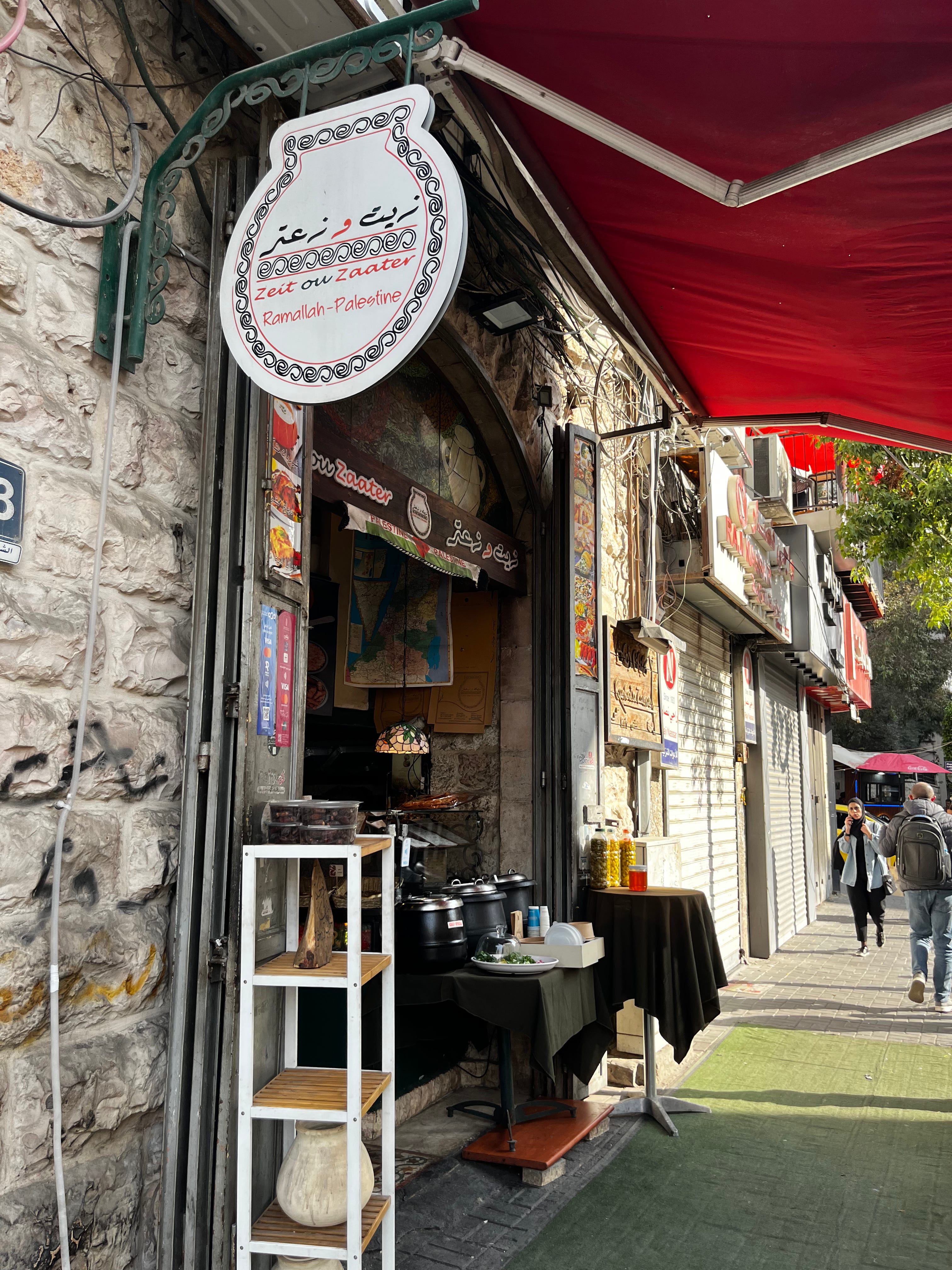
By ten o’clock we had arrived in Ramallah and were sitting in Zeit & Zaatar.
I have been coming to this café for twenty years. The green-painted handrails heading up the narrow stairs are heavy with successive layers applied year after year — they have the heft of accumulated time, thicker and more substantial than when they were first fitted, like many of us. The oil painting has been in the stairwell as long as I can remember. The woven bread trays on the walls, the frames with mass-produced posters for events long since past — landscapes from another place, inspirational musings on resistance, love, peace, the emotions Palestinians must balance and contest on a daily basis while they trudge through a never-ending occupation. I’ve seen all of it before. It felt exactly like coming home.
I ordered what I always order: za’atar fatayer wa jibneh — warm, oily dough layered with fresh wild thyme leaves and salty Akkawi white cheese, baked in. It smells faintly musky and herbal. The first bite is salty and bright and earthy all at once. I have never had a bad za’atar fatayer wa jibneh and I have eaten a great many of them, but this one, in this place, after this long away — I cannot explain it better than to say that this is Palestine for me. Of all the food, this is the thing. The trip doesn’t actually begin until that first bite. Everything before it is just transit.
In 2023, my wife and I brought our teenage children to Zeit & Zaatar for their first real visit — they had been here as babies, which counts for nothing in memory. We ordered a tray of za’atar fatayer wa jibneh and other Palestinian breads and glasses of hot mint tea with what I can only describe as diabetic levels of sugar. It remains, as far as I can tell, one of the highlights of their lives. That makes me unreasonably happy.
My friend was working through his own observational method that morning — write what you see, document the surface, let the room speak before you interpret it. I was following along, loosely, trying to see the familiar café the way someone new to it might. That’s when I noticed the map.
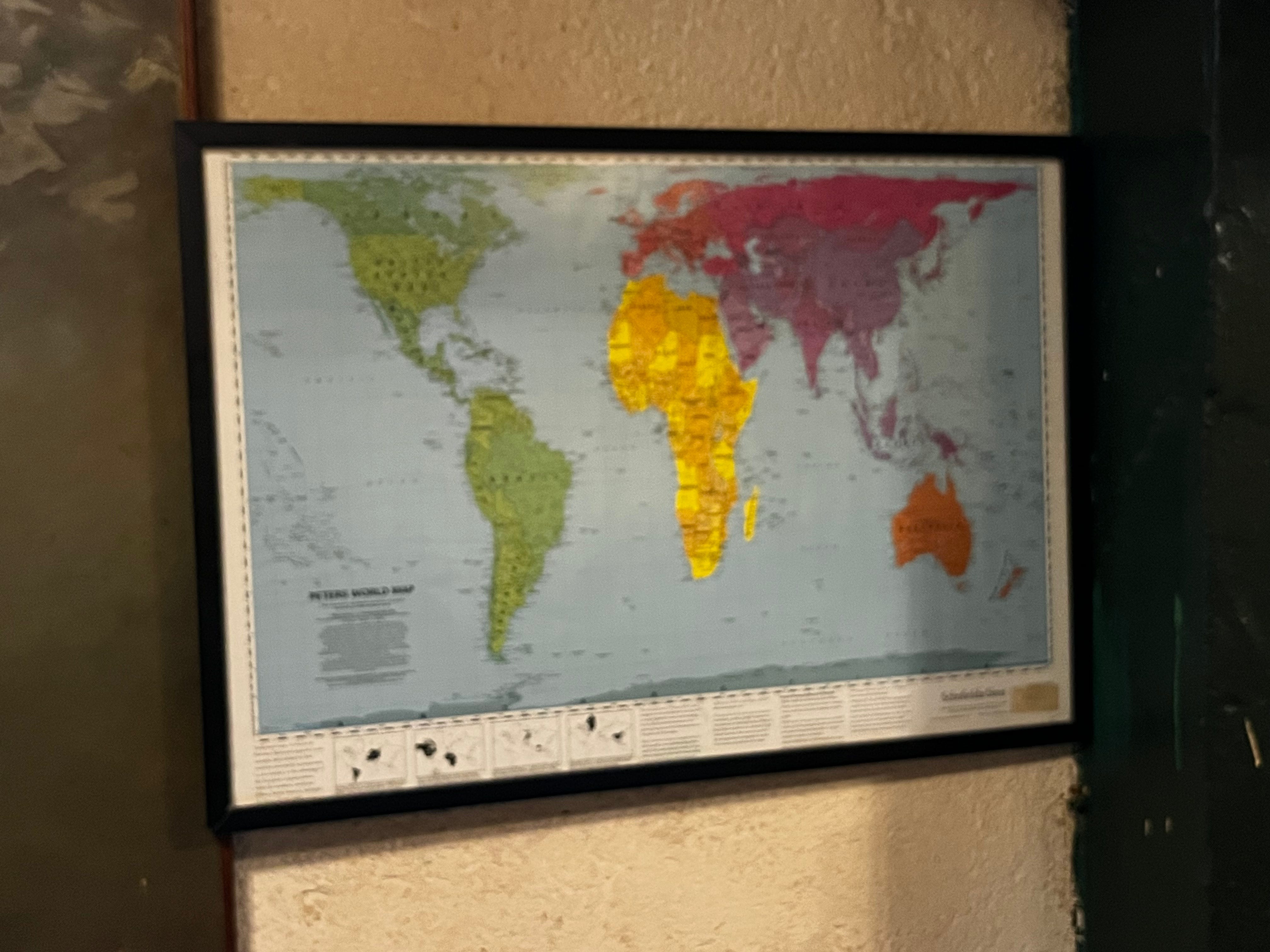
Not a map of Palestine — those are everywhere and often unremarkable. This was a political map of the world: the Americas in green, Africa in yellow, Europe a maroon-inspired shade, Asia in plum, Australia burnt orange. Standard enough at first glance. But the projection was Peters — the map that elongates our spherical world as it flattens it into two dimensions, shrinking the visual dominance of Canada, Greenland, the United States, and Europe while Africa suddenly expands into something closer to its actual size. The colonial powers made smaller. The colonized world made larger. One deliberate act of reframing, hanging on the wall of a café in a city that has been reframed by outside powers for centuries. Peters projections aren’t new — they’ve been around for decades — but I suspect whoever hung that map knew exactly what they were doing.
After a few hours in Ramallah we got back in the car and headed to Taybeh. The navigation system abandoned us again as we turned off Route 60 and made our way to Taybeh — the same warning, the same sudden disappearance of routing, the same assumption that we had made a terrible mistake by being where we were. We had not. The roads were fine. We knew where we were going.
The questions these navigation systems raised I haven’t been able to stop thinking about since. Who decided that crossing into the West Bank required a danger warning? How were the trigger coordinates determined? Is there an appeals process? And — perhaps most pointedly — would the same warning appear for someone driving into the Golan Heights? Both Google Maps and Waze issued identical warnings at identical moments. That is not a coincidence. That is a decision someone made, encoded into an algorithm, applied to a geography. I have my suspicions about whose decision it was. They had not, after all, managed the Shabbat routing either.
It had been eleven years since I’d done real fieldwork here. A decade in university administration — the work of running things rather than studying them — had pulled me away from the places and the questions that brought me into this field in the first place. Driving roads I’ve known for twenty years, eating food that tastes like the best version of coming home, glimpsing a Peters projection map hanging on a café wall in Ramallah and understanding immediately why it was there — I kept thinking about how much I had missed this. Not just the place. The work. The specific quality of attention that fieldwork requires — the obligation to be present, to notice, to sit with what you’re seeing before you decide what it means.
I’m back now. It took longer than it should have.